English Exams in Taiwan: A Parent’s Guide to Cambridge English and GEPT
For families in Taiwan, Cambridge English Qualifications and GEPT (全民英檢) are two different ways to measure and demonstrate a student’s English ability. GEPT was developed specifically for learners in Taiwan and assesses listening, reading, speaking and writing (Language Training and Testing Center, “GEPT簡介”; Language Training and Testing Center, The General English Proficiency Test). Cambridge English offers a qualification pathway that begins with young learners and continues through advanced English (Cambridge English, “About Our Qualifications”).
Neither pathway is automatically “better.” The more useful question is: What is your child’s current English level, why are they taking an exam, and what might they eventually want that qualification to do for them?

Key takeaways for parents
GEPT is particularly relevant in Taiwan. The Language Training and Testing Center (LTTC) currently reports that around 120 Taiwanese universities and colleges use GEPT in connection with English graduation requirements or first-year English-course exemptions, while more than 600 university departments include GEPT among admissions-review materials (Language Training and Testing Center, “大專院校”).
Cambridge English has a broad international recognition network. Cambridge reports that more than 25,000 higher-education institutions, employers and governments worldwide accept its qualifications and tests (Cambridge English, “Qualifications for Higher Education”).
Those figures should not be compared as if they measure exactly the same thing. Cambridge’s figure includes higher-education institutions, employers and governments around the world; LTTC’s figures above describe particular uses of GEPT within Taiwanese higher education.
Both systems can be understood through CEFR. The Common European Framework of Reference for Languages, or CEFR, describes language proficiency across six main levels—A1, A2, B1, B2, C1 and C2. CEFR is a framework for describing language ability, not an English exam itself (Council of Europe, “The CEFR Levels”).
And the value of an English qualification changes as students progress. Pre-A1 Starters, A1 Movers and A2 Flyers are early learning milestones. Higher-level qualifications can have more concrete uses, including satisfying specific university English requirements.
Why English exams can matter beyond test scores
Parents often hear that English exams can motivate children, build confidence or give them a goal to work toward.
Those benefits can matter. But as students progress to higher levels, English qualifications can have a much more tangible purpose.
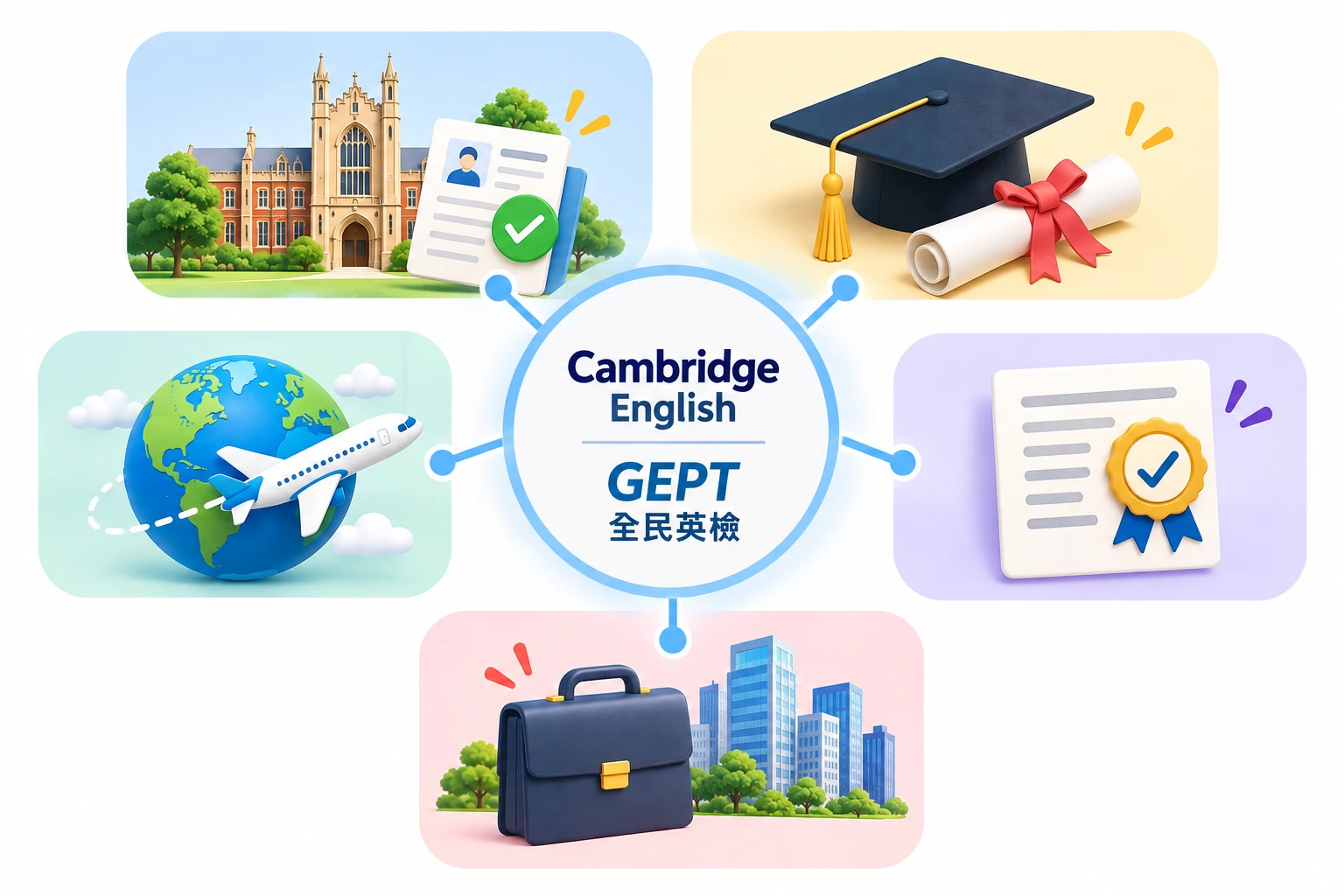
Depending on the qualification and institution, an English test result may be used as evidence of English proficiency for university requirements, course exemptions, graduation requirements, international study or other formal purposes.
Consider a real example in Taiwan.
National Cheng Kung University’s Department of Statistics and Data Science currently requires applicable master’s students admitted in or after the 2022–23 academic year to complete an English-proficiency requirement before graduation. One of the listed options is the second stage of GEPT High-Intermediate or above (National Cheng Kung University, Department of Statistics and Data Science, “Department of Statistic”).
Now consider an international example.
The University of Oxford currently accepts Cambridge C1 Advanced and C2 Proficiency among the qualifications that can satisfy its undergraduate English-language requirement. Oxford currently lists a required score of 191 overall with at least 185 in each component for both qualifications (University of Oxford, “English Language and Visa Requirements”).
That does not mean earning C1 Advanced gets a student into Oxford. Oxford separately requires applicants to meet its academic admissions requirements.
But it demonstrates something important:
At higher levels, an English qualification can become more than proof that a student studied English. It can satisfy an actual English-language requirement connected to an educational opportunity.
What is GEPT?
The General English Proficiency Test, or GEPT (全民英檢), was developed for learners in Taiwan and is administered by the Language Training and Testing Center. LTTC describes GEPT as a standardized English proficiency assessment covering listening, reading, speaking and writing (Language Training and Testing Center, “GEPT簡介”; Language Training and Testing Center, The General English Proficiency Test).
GEPT has five main proficiency levels:
| GEPT level | CEFR level |
|---|---|
| Elementary 初級 | A2 |
| Intermediate 中級 | B1 |
| High-Intermediate 中高級 | B2 |
| Advanced 高級 | C1 |
| Superior 優級 | C2 |
LTTC’s published GEPT–CEFR alignment places Elementary at A2, Intermediate at B1, High-Intermediate at B2, Advanced at C1 and Superior at C2 (Language Training and Testing Center, The General English Proficiency Test).
For Taiwanese families, an important feature of GEPT is that it already has established uses within Taiwan’s education system.
LTTC currently reports that approximately 120 Taiwanese universities and colleges use GEPT in connection with English graduation requirements or first-year English-course exemptions. It also reports that more than 600 university departments include GEPT as part of admissions review (Language Training and Testing Center, “大專院校”).
Those are aggregate figures reported by LTTC. The exact requirement of a particular university or department should always be checked directly with that institution.
What are Cambridge English Qualifications?
Cambridge English Qualifications are a series of English assessments provided by Cambridge University Press & Assessment.
For children and teenagers, the pathway can begin below CEFR A1 and continue all the way to C2:
Pre-A1 Starters → A1 Movers → A2 Flyers → A2 Key for Schools → B1 Preliminary for Schools → B2 First for Schools → C1 Advanced → C2 Proficiency.
Cambridge describes these qualifications as a step-by-step learning journey, with each qualification targeting a particular CEFR level (Cambridge English, “About Our Qualifications”).
This means Cambridge English can function as a long-term pathway rather than a single isolated test.
A young child might begin with Starters, progress to Movers and Flyers, and later work toward qualifications such as B1 Preliminary, B2 First or C1 Advanced.
Cambridge reports that more than 25,000 higher-education institutions, employers and governments worldwide accept its qualifications and tests (Cambridge English, “Qualifications for Higher Education”).
But that number needs to be understood correctly.
It does not mean that every one of those organizations accepts every Cambridge qualification for every purpose. A university might accept C1 Advanced as evidence of English proficiency while having no use for a young child’s Starters certificate.
Recognition needs to be checked for the specific qualification and specific institution involved.
Cambridge English and GEPT compared by CEFR level
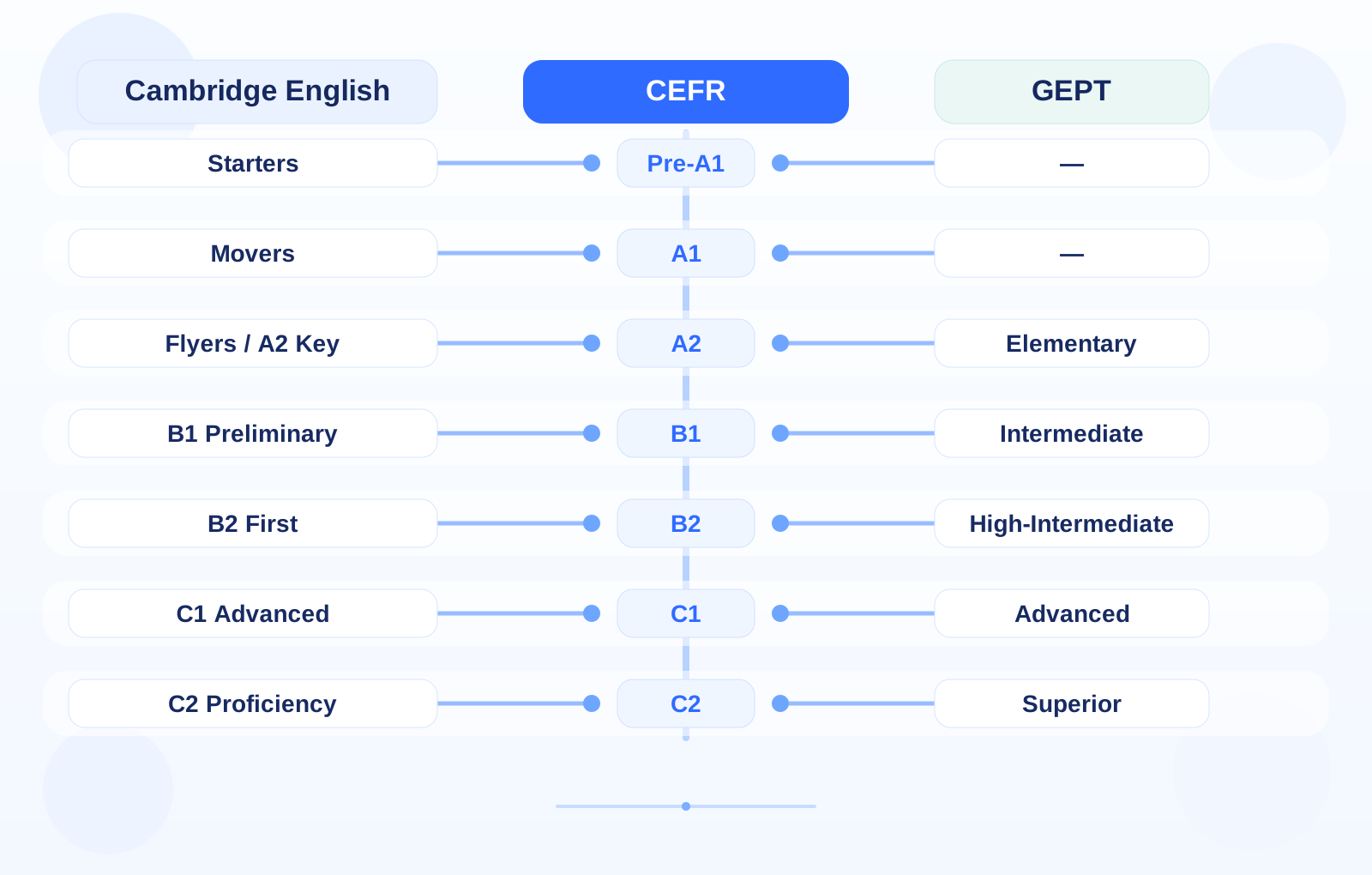
CEFR gives parents a useful way to understand roughly where the two systems sit in relation to one another.
The Council of Europe organizes language proficiency into six main levels from A1 to C2, grouped broadly into Basic, Independent and Proficient users (Council of Europe, “The CEFR Levels”).
| CEFR level | Cambridge English pathway | GEPT |
|---|---|---|
| Pre-A1 | Pre-A1 Starters | — |
| A1 | A1 Movers | — |
| A2 | A2 Flyers / A2 Key | Elementary |
| B1 | B1 Preliminary | Intermediate |
| B2 | B2 First | High-Intermediate |
| C1 | C1 Advanced | Advanced |
| C2 | C2 Proficiency | Superior |
The Cambridge levels come from Cambridge’s qualification pathway, while the GEPT alignment comes from LTTC’s published GEPT–CEFR material (Cambridge English, “About Our Qualifications”; Language Training and Testing Center, The General English Proficiency Test).
There is an important warning here:
Two exams associated with the same CEFR level are not automatically the same exam or interchangeable qualifications.
GEPT Intermediate and Cambridge B1 Preliminary both relate to B1, for example, but they have their own formats, scoring systems and institutional recognition.
CEFR gives us a common language for describing proficiency. It does not make different examinations identical.
What can GEPT actually be used for?
GEPT’s strongest institutional presence is in Taiwan.
LTTC’s current higher-education information states that GEPT is used by Taiwanese universities for purposes including graduation English requirements, first-year English-course exemptions and admissions review (Language Training and Testing Center, “大專院校”).
Individual university policies show what that can mean in practice.
National Cheng Kung University’s Department of Statistics and Data Science states that applicable master’s students must satisfy an English threshold before graduation. The department accepts the second stage of GEPT High-Intermediate or above as one of several ways of meeting that requirement (National Cheng Kung University, Department of Statistics and Data Science, “Department of Statistic”).
The currently published graduation-threshold page for NCKU’s Department of Foreign Languages and Literature gives another example. It lists GEPT Advanced preliminary stage among the qualifications that can satisfy that department’s undergraduate English graduation threshold (National Cheng Kung University, Department of Foreign Languages and Literature, “大學部英文畢業門檻規定”).
These examples show why the question “Is GEPT useful?” is too broad.
A better question is:
“What GEPT level could become useful for the educational path my child may eventually follow?”
Is GEPT useful outside Taiwan?
GEPT is not restricted completely to domestic use.
LTTC currently states that 97 universities across 27 countries use GEPT results as an English-proficiency reference for Taiwanese students applying to certain degree or exchange programs (Language Training and Testing Center, “GEPT簡介”).
LTTC also maintains an international-recognition list showing examples of universities, program types and GEPT levels associated with recognition (Language Training and Testing Center, “Universities that Recognize the GEPT”).
These are LTTC-reported recognition figures. A student planning to use GEPT for an overseas application should still check the destination university or program directly before choosing an exam.
What can Cambridge English qualifications actually be used for?
Cambridge English publishes a broad international recognition network.
Cambridge currently reports that more than 25,000 higher-education institutions, employers and governments worldwide accept its qualifications or tests (Cambridge English, “Qualifications for Higher Education”).
At higher qualification levels, that can translate into concrete educational requirements.
The University of Oxford currently accepts C1 Advanced and C2 Proficiency among the qualifications that can satisfy its undergraduate English-language requirement. Oxford lists an overall score of 191 and a minimum score of 185 in each component for both qualifications (University of Oxford, “English Language and Visa Requirements”).
Again, that does not mean the qualification gets the student admitted to Oxford. It means the qualification can be used to satisfy Oxford’s English-language requirement when the specified conditions apply.
Cambridge qualifications can also have uses inside Taiwan.
The currently published English graduation-threshold page for National Cheng Kung University’s Department of Foreign Languages and Literature lists Cambridge Main Suite Advanced (CAE) or above among its accepted options (National Cheng Kung University, Department of Foreign Languages and Literature, “大學部英文畢業門檻規定”). Cambridge states that the qualification formerly known as Cambridge English: Advanced (CAE) is now called C1 Advanced (Cambridge English, “C1 Advanced”).
So it is too simplistic to think:
GEPT = Taiwan
Cambridge English = overseas
A more accurate picture is that GEPT has established institutional uses inside Taiwan and some overseas recognition, while Cambridge English publishes a global recognition network spanning higher education, employers and governments.
The recognition figures published by Cambridge and LTTC should not be compared directly because they describe different kinds of organizations and uses.
What do Starters, Movers and Flyers actually give a child?
This distinction is particularly important for parents of younger students.
Pre-A1 Starters, A1 Movers and A2 Flyers should not be confused with higher-level English qualifications that universities may accept for formal English requirements.
They serve a different purpose.
The three exams create the early stages of the Cambridge pathway:
Pre-A1 → A1 → A2.
Cambridge states that there is no pass or fail in Starters, Movers and Flyers. Candidates who complete the exams receive a Statement of Results and a certificate showing what they can do (Cambridge English, Pre A1 Starters, A1 Movers and A2 Flyers: Handbook for Teachers).
So the tangible value for a young child is not:
“This certificate qualifies me for university.”
Instead, these exams provide recognized milestones within a structured English-learning pathway.
Cambridge’s own pathway shows young learners moving from Starters through Movers and Flyers before progressing into qualifications such as A2 Key for Schools, B1 Preliminary for Schools and B2 First for Schools (Cambridge English, “About Our Qualifications”).
As students progress, the possible uses of their qualifications can become more concrete.
That is a more useful way for parents to understand the early Cambridge exams.

Which pathway should a student in Taiwan follow?
There is no single correct answer for every child.
If a family’s goals are mainly connected to Taiwan’s education system, GEPT may be worth considering because it already has established uses across Taiwanese universities and other institutions.
If a family expects a student eventually to pursue international education or wants a qualification with broad international recognition, Cambridge English may also be worth considering because of its international recognition network.
For younger children, Cambridge additionally provides formal milestones at Pre-A1 and A1, before GEPT Elementary at A2.
But parents do not need to make a permanent decision about their child’s entire English-exam pathway at eight or ten years old.
It can be more useful to think in this order:
What is my child’s English level now?
What is the next realistic language goal?
Is there a meaningful reason to earn a qualification at that stage?
If there is a specific school, university or program in the future, what qualification does that institution actually accept?
That avoids building a child’s entire English education around an exam simply because the exam is popular.
Can a student prepare for both Cambridge and GEPT?
Yes.
The two systems are different examinations, but students do not need completely separate English abilities for each one.
GEPT covers listening, reading, speaking and writing across its proficiency framework (Language Training and Testing Center, The General English Proficiency Test). Cambridge qualifications likewise assess core language skills; for example, B1 Preliminary consists of Reading, Writing, Listening and Speaking components (Cambridge English, “B1 Preliminary for Schools and B1 Preliminary Exam Format”).
That means improvements in vocabulary, reading comprehension, listening, grammar, speaking and writing can remain useful even if a student later changes exam systems.
CEFR helps illustrate this.
GEPT Intermediate and B1 Preliminary both relate to B1. GEPT High-Intermediate and B2 First relate to B2 (Language Training and Testing Center, The General English Proficiency Test; Cambridge English, “About Our Qualifications”).
But students still need exam-specific preparation before taking a particular test. Similar proficiency levels do not mean identical task types, timing or scoring.
The underlying English ability transfers more easily than the exam technique.
Where vocabulary fits
Neither Cambridge English nor GEPT is simply a vocabulary test.
Students also need listening comprehension, reading comprehension, grammar, speaking and writing appropriate to their level.
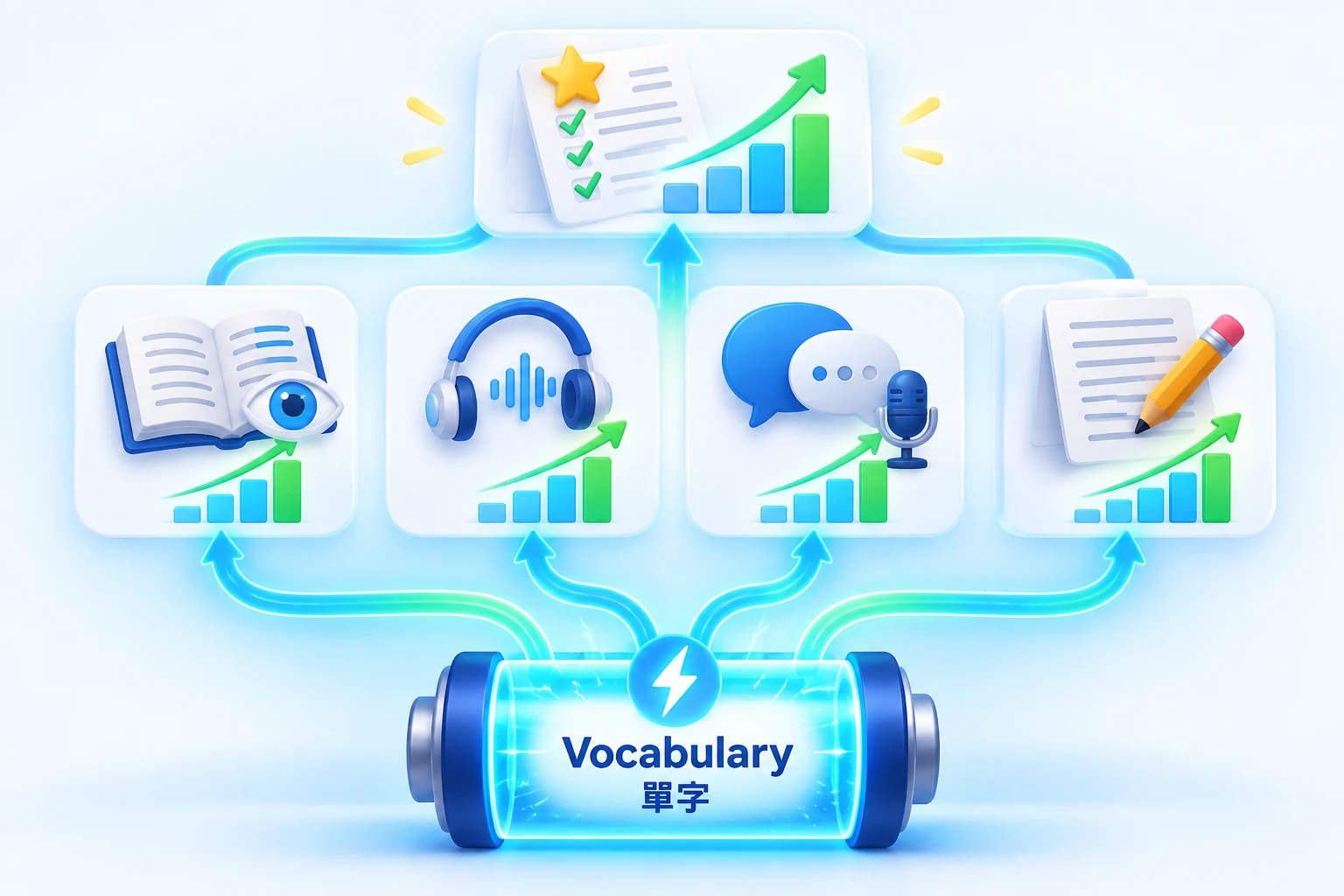
But vocabulary sits underneath all of those skills.
A student may understand the grammar of a reading passage yet still struggle because too many important words are unfamiliar.
Listening becomes difficult when the sentence structure is understandable but key words are not recognized.
Speaking becomes limited when a student knows what they want to say but cannot retrieve the vocabulary needed to express it.
Writing becomes repetitive when a learner has too small a usable vocabulary.
Official Cambridge preparation materials make vocabulary an explicit part of exam preparation. Cambridge publishes wordlist materials for Pre-A1 Starters, A1 Movers and A2 Flyers, and its A2 Key preparation materials include a vocabulary list for A2 Key and A2 Key for Schools (Cambridge English, “A2 Flyers Preparation”; Cambridge English, “Preparing for A2 Key for Schools and A2 Key”).
Vocabulary also appears directly in exam tasks and assessment. For example, Cambridge’s B1 Preliminary Reading includes a multiple-choice cloze requiring candidates to choose correct vocabulary items, while the Writing component assesses whether candidates can use vocabulary and structure correctly (Cambridge English, “B1 Preliminary for Schools and B1 Preliminary Exam Format”).
That is the particular part of preparation FocusVocab is designed to address.
FocusVocab helps students systematically learn, review and retain vocabulary relevant to English qualification pathways.
It is not intended to replace complete Cambridge English or GEPT preparation. Students still need the other language skills and familiarity with the particular exam they plan to take.
The goal is more specific:
Make sure vocabulary is not the thing holding the student back as the English around them becomes more difficult.
FocusVocab is an independent learning platform and is not affiliated with, endorsed by or sponsored by Cambridge University Press & Assessment or the Language Training and Testing Center.
Important distinctions for parents
The most important thing to understand about English qualifications is that their value depends on context.
A university accepting C1 Advanced does not mean every university requires C1 Advanced.
A department accepting GEPT High-Intermediate does not mean every department in Taiwan uses the same threshold.
A qualification being “recognized” does not necessarily mean it is “required.”
And satisfying an English-language requirement does not mean a student automatically qualifies for admission.
Two examinations being mapped to the same CEFR level does not automatically mean an institution will accept either one.
Requirements can also change.
If your child eventually wants to use an English qualification for a particular university, exchange program, employer or other formal purpose, check that institution’s current official requirements before registering for an exam specifically to satisfy them.
Frequently asked questions
Is Cambridge English better than GEPT?
Neither is universally better.
GEPT has established uses within Taiwan’s education system, while Cambridge English publishes a broad international recognition network. The useful choice depends on the student’s age, current English level and intended use of the qualification (Language Training and Testing Center, “大專院校”; Cambridge English, “Qualifications for Higher Education”).
Is GEPT recognized outside Taiwan?
Yes, for some purposes. LTTC currently reports that 97 universities in 27 countries use GEPT results as an English-proficiency reference for Taiwanese students applying to certain degree or exchange programs (Language Training and Testing Center, “GEPT簡介”).
Students should confirm the current requirement directly with the individual overseas institution.
Are Cambridge Starters, Movers and Flyers pass-or-fail exams?
No. Cambridge states that there is no pass or fail in Starters, Movers and Flyers. Candidates who complete the exams receive a Statement of Results and a certificate showing what they can do (Cambridge English, Pre A1 Starters, A1 Movers and A2 Flyers: Handbook for Teachers).
What GEPT level is similar to Cambridge B1 Preliminary?
In CEFR terms, GEPT Intermediate and Cambridge B1 Preliminary both relate to B1 (Language Training and Testing Center, The General English Proficiency Test; Cambridge English, “About Our Qualifications”).
That does not mean they are the same exam or that every institution treats them as interchangeable.
What GEPT level is similar to Cambridge B2 First?
In CEFR terms, GEPT High-Intermediate and Cambridge B2 First both relate to B2 (Language Training and Testing Center, The General English Proficiency Test; Cambridge English, “About Our Qualifications”).
Again, this is a comparison of proficiency level, not a statement that the two exams are identical.
Can Cambridge English be useful at a Taiwanese university?
Yes, in some cases. For example, the currently published English graduation-threshold page for NCKU’s Department of Foreign Languages and Literature lists Cambridge Main Suite Advanced (CAE) or above among its accepted options (National Cheng Kung University, Department of Foreign Languages and Literature, “大學部英文畢業門檻規定”).
Can GEPT affect university requirements in Taiwan?
Yes, at some universities and departments.
For example, NCKU’s Department of Statistics and Data Science currently lists the second stage of GEPT High-Intermediate or above among the ways applicable master’s students can satisfy its English threshold before graduation (National Cheng Kung University, Department of Statistics and Data Science, “Department of Statistic”).
Does passing one of these exams guarantee university admission?
No.
An English qualification may satisfy an institution’s English-language requirement, but the student still has to meet the institution’s other academic and admissions requirements. Oxford’s undergraduate guidance, for example, discusses its English-language requirement separately from admission to the university (University of Oxford, “English Language and Visa Requirements”).
Should a child study only vocabulary for these exams?
No.
Vocabulary is foundational, but complete exam preparation also involves the other language skills, grammar where relevant, and familiarity with the particular exam’s format.
Last reviewed: 25 September 2026
Works Cited
Cambridge English. “About Our Qualifications.” Cambridge English, Cambridge University Press & Assessment. Accessed 25 Sept. 2026.
Cambridge English. “A2 Flyers Preparation.” Cambridge English, Cambridge University Press & Assessment. Accessed 25 Sept. 2026.
Cambridge English. “B1 Preliminary for Schools and B1 Preliminary Exam Format.” Cambridge English, Cambridge University Press & Assessment. Accessed 25 Sept. 2026.
Cambridge English. “C1 Advanced.” Cambridge English, Cambridge University Press & Assessment. Accessed 25 Sept. 2026.
Cambridge English. Pre A1 Starters, A1 Movers and A2 Flyers: Handbook for Teachers. Cambridge University Press & Assessment. Accessed 25 Sept. 2026.
Cambridge English. “Preparing for A2 Key for Schools and A2 Key.” Cambridge English, Cambridge University Press & Assessment. Accessed 25 Sept. 2026.
Cambridge English. “Qualifications for Higher Education.” Cambridge English, Cambridge University Press & Assessment. Accessed 25 Sept. 2026.
Council of Europe. “The CEFR Levels.” Common European Framework of Reference for Languages. Council of Europe. Accessed 25 Sept. 2026.
Language Training and Testing Center. “大專院校.” 全民英檢 GEPT. Accessed 25 Sept. 2026.
Language Training and Testing Center. “GEPT簡介.” 全民英檢 GEPT. Accessed 25 Sept. 2026.
Language Training and Testing Center. The General English Proficiency Test. Language Training and Testing Center. Accessed 25 Sept. 2026.
Language Training and Testing Center. “Universities that Recognize the GEPT.” 全民英檢 GEPT. Accessed 25 Sept. 2026.
National Cheng Kung University, Department of Foreign Languages and Literature. “大學部英文畢業門檻規定.” National Cheng Kung University. Accessed 25 Sept. 2026.
National Cheng Kung University, Department of Statistics and Data Science. “Department of Statistic.” National Cheng Kung University, updated 6 Aug. 2026. Accessed 25 Sept. 2026.
University of Oxford. “English Language and Visa Requirements.” University of Oxford. Accessed 25 Sept. 2026.